
How to Search Civil Dockets
Match the search to the subject of the case. Suits over contracts, injuries, and other general disputes belong to Circuit Court. Most jury matters sit there too. Chancery Court takes divorce, custody, adoption, alimony, guardianship, conservatorship, wills, estates, land, title, and equity. That split shapes every Newton County civil docket lookup. Use the court named on any notice or prior docket entry when you have one. Otherwise, describe the case category to the clerk before paying for a remote search. Both Newton Circuit and Chancery participate in MEC. Their electronic histories differ, and each office keeps its own docket custody. A civil matter may stem from a lower-court appeal. But the Justice Court small-claims record and the Circuit appeal record are separate things. A PAMEC result helps only after you know which Newton County office holds the file.
- Name the court suggested by the case category.
- Search PAMEC for a participating electronic case using a known number first.
- If a name search is necessary, narrow it with a filing date, case type, or party role.
- Read the docket sheet before opening a document or requesting a copy.
- Use the Circuit Clerk or Chancery Clerk for clerk-terminal, paper-file, copy, and certification questions.
Newton County Civil Search Request Details
Give the clerk something precise to work with. A good civil search request names the likely court, a party or agency, and the case number if known. Add the case category and a range of filing dates. Those details let the office separate a general Circuit civil matter from a Chancery family, probate, estate, land, or equity file. Name-only searches get murky fast. Similar names show up in more than one court. Older records may fall outside the court's electronic history. For remote work, PAMEC offers registered read-only access to participating courts. The current terms charge $10 per year to register, plus $0.20 for each result page. A no-match result still counts as a page. So narrow the request first: the correct court, plus a case number when one exists. For paper files, archived records, copies, or certifications, ask the Circuit Clerk or Chancery Clerk which office holds the file. Do that before authorizing research.
Newton County Civil Court Paths
One courthouse, two civil docket paths. Circuit Clerk Michael L. Butler holds Circuit civil filings. Chancery Clerk Chrissie Buffington holds Chancery matters. Finding nothing in Circuit MEC does not prove a Chancery case is absent, and a Chancery search will not cover a general civil or lower-court appeal docket. Justice Court small claims of $3,500 or less run through a separate lower-court route. The split matters after filing too. A Circuit filing, summons, judgment, execution, or appeal request moves through the Circuit Clerk's record system. Divorce, estate, guardianship, land, and equity requests belong to the Chancery Clerk. When a case description leans on broad words like property or family, hand the office a document title and case number so staff can confirm custody rather than send your request down the wrong path.
| Court | Typical civil matters | Clerk route |
|---|---|---|
| Circuit Court | General civil jurisdiction, jury matters, and lower-court appeals | Newton County Circuit Clerk |
| Chancery Court | Domestic, probate, estate, guardianship, land, and equity matters | Newton County Chancery Clerk |
| Justice Court | Small claims of $3,500 or less | Justice Court Clerk |
What a Civil Docket Shows
A civil docket normally lists the case number, the parties and their roles, filings, notices, settings, orders, judgment activity, and appeal events. Treat it as the case index. No docket promises that every exhibit, transcript, or recorded land instrument sits online. If an entry appears with no public link, ask for that document by name. Read entries in order: the date, the event title, then whatever follows. A status like closed, stayed, appealed, or pending does not spell out what an order actually does. A judgment entry might trail into a post-trial motion, execution, garnishment, satisfaction, cancellation, or an appeal. It may even end in an appeal. The docket tells you what to request from the clerk. It cannot replace a signed order or a certified copy when the court requires one.
| Case number | The court identifier, such as 2025-CV-00001, used to distinguish similar party names. |
|---|---|
| Commencement | Complaint, petition, summons, and service or return entries. |
| Case activity | Answer, motions, discovery, scheduling order, mediation, or arbitration entries. |
| Outcome | Judgment, dismissal, satisfaction, cancellation, execution, or appeal event. |
| Status | Open, closed, stayed, appealed, sealed, or another system marker requiring context. |
Newton County Civil Docket Indexes and Documents
The docket is a dated index; the court record behind it holds the actual documents. An index entry may point to a complaint, summons, answer, motion, or scheduling order. It may also point to a judgment, execution, garnishment, satisfaction, cancellation, or appeal. A search result guarantees none of it is online. Exhibits, transcripts, discovery material, and recorded land instruments may sit elsewhere or in paper. Use the docket to pin down a document title and its filing or event date. Then request that specific public item from the custodian. This matters when a file is an image PDF rather than searchable text. It also matters when a file exists only on paper, needs certification, or is restricted. The docket supports a targeted records request. It is no substitute for a signed order, a complete file, or a separately recorded land record.
Newton County Chancery MEC Access
Newton County Chancery Court went live on MEC on September 16, 2019. Its Second Chancery MEC CourtInfo record shows the electronic court layer serves a distinct court. It is not just a Circuit Court category. PAMEC gives registered, read-only public access. Current terms list a $10 annual registration charge plus $0.20 per search-result page. A no-match result still bills as a page, so search by case number when you can. Source: Second Chancery MEC Court Information.
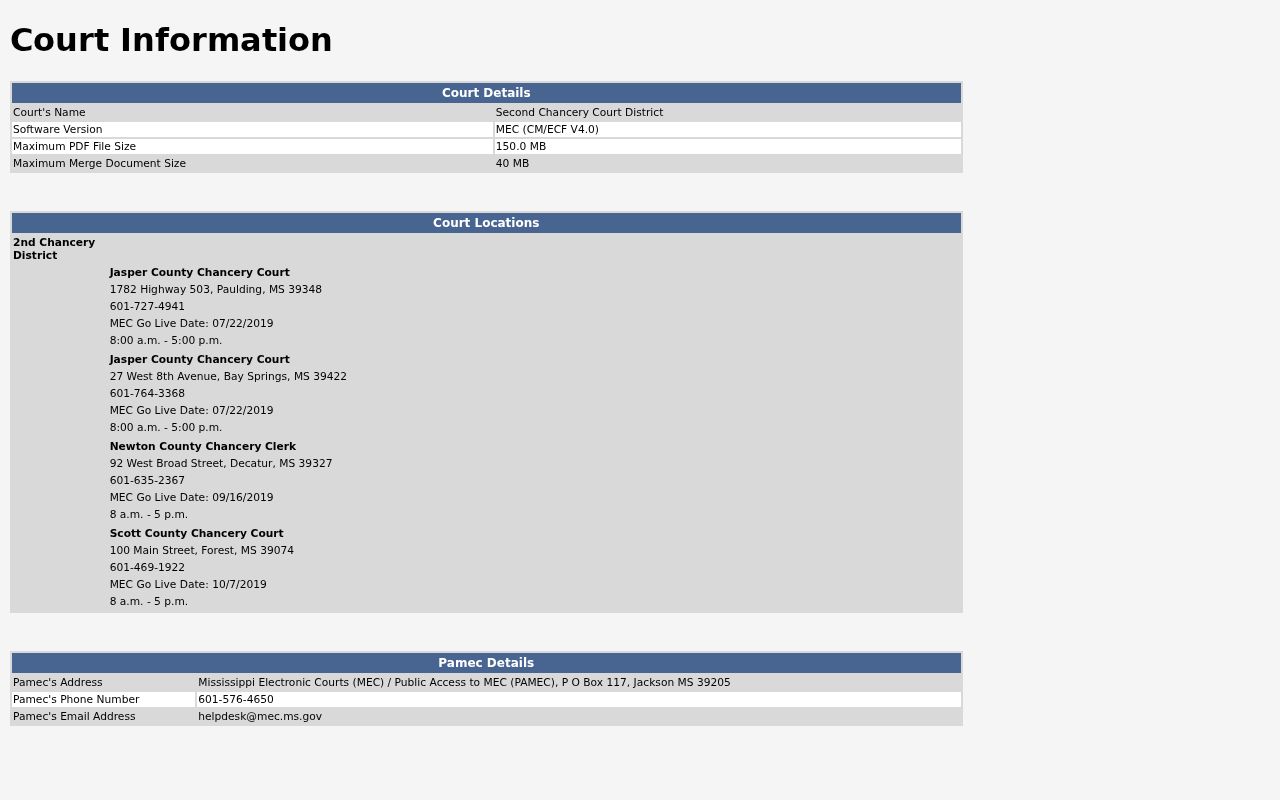
The CourtInfo page shows how the local Chancery Court takes part in electronic filing and helps you tell its access apart from Circuit civil access.
Types of Civil Cases on the Docket
A Newton County civil docket entry usually marks one step in a case's life. A Circuit case may move from complaint and service, through an answer and motion practice, into a scheduling order, trial, judgment, and finally a collection effort. Chancery matters run on petitions and orders instead. Family, probate, estate, guardianship, land, and equity disputes all live there. Even when the index is visible, some categories hold redacted or restricted material.
The papers behind an entry may sit somewhere else entirely. A judgment docket does not guarantee full paperwork on one screen. Exhibits, transcripts, discovery items, and recorded land instruments may come from separate sources. Before calling, gather the filing's title. Note its filing or event date. Also decide whether you want a public, plain, or certified copy. With that, the right Newton County clerk can quote the correct process and fee.
For the documented future Chancery-district change, read Mississippi Senate Bill 2768 yourself.
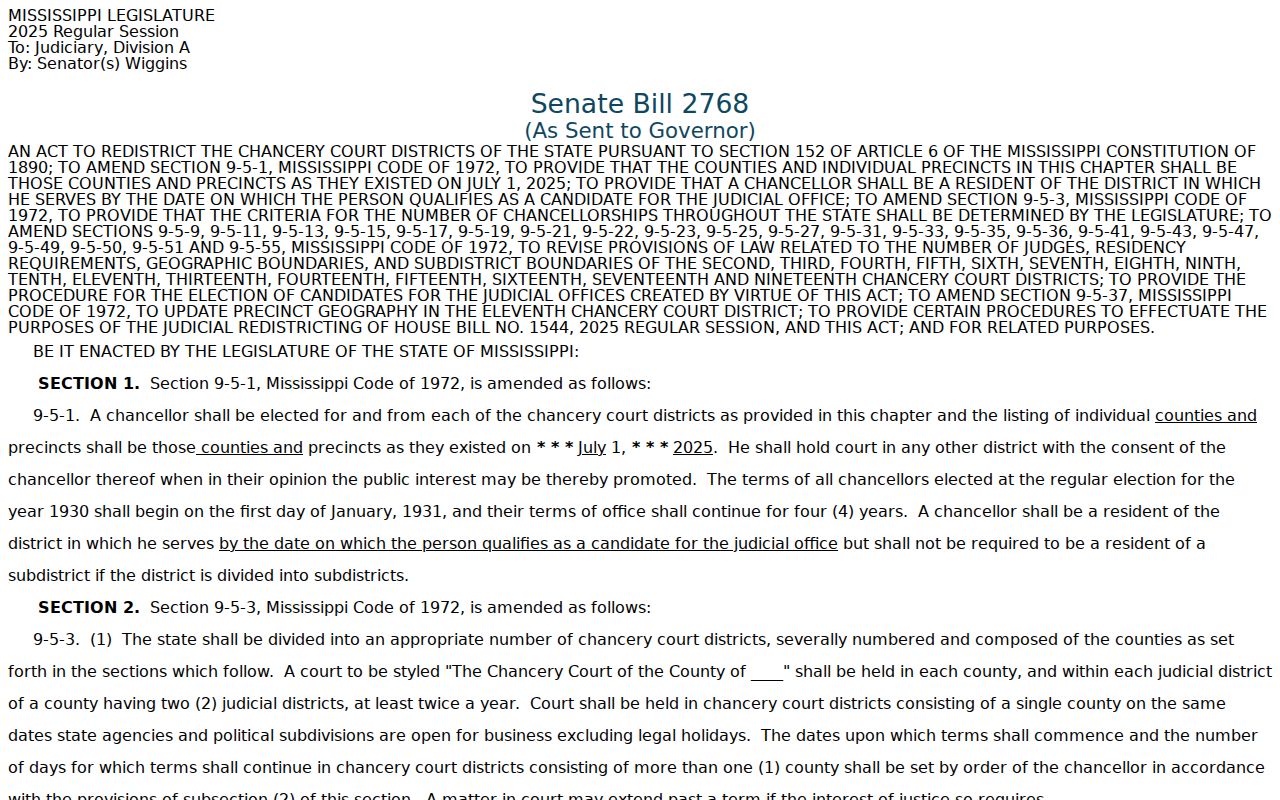
The bill text is the reference point for the coming Chancery-district shift. When the change actually takes effect, confirm details against current court-directory information rather than assuming the statute alone reflects day-to-day operations.
Newton County Circuit Civil MEC History
Dates tell a story here. Newton County Circuit Court went live on MEC on September 16, 2024. Chancery did so on September 16, 2019, a five-year gap. That gap is a real search clue. An older Circuit civil case may still live in a paper or legacy collection and need clerk help. A Chancery case of the same vintage may already have a full electronic history. One caution: an online absence never proves the civil file never existed.
PAMEC gives registered, read-only access for participating courts. It has limits. It cannot turn scanned pages into searchable text. It will not open a document that carries a restriction. When in doubt, ask a clerk. The clerk can tell you whether your request touches an available public docket, a paper file, an archived record, or something needing a narrower request.
Settings and Hearings on Civil Dockets
A setting can serve many purposes. It might be an initial appearance or a motion hearing. It could be a scheduling conference, mediation, a trial, or a post-judgment matter. None of that promises an issue gets decided that day. A later notice, order, reset, continuance, or clerk confirmation can change everything. So rely on the newest docket event for that case. Ask the responsible clerk to verify the court, date, and time.
Plan around the latest case-specific notice or docket event, not a general term calendar. Keep in mind that a mediation, arbitration, or case-management entry shows activity. It is not a settlement or any other result. For anything time-sensitive, hand the Circuit or Chancery clerk the case number. Ask which setting, order, or notice controls right now. Justice Court and municipal dates are separate; confirm those with their own clerks.
- Service or return
- An entry showing process activity, not a ruling on the claim.
- Scheduling order
- A court order that sets milestones or a case-management path.
- Judgment
- A court ruling that should be read with any later post-trial or appeal entry.
- Satisfaction or cancellation
- A docket event that can follow a judgment or related record.
Newton County Civil Lower-Court Appeal Records
A small claim worth $3,500 or less starts in Justice Court. Lose there, and the appeal moves to a different office: the Newton County Circuit Clerk. That clerk's posted fee schedule prices a civil appeal from lower court at $161. Keep your paperwork organized. The appeal file and the original Justice Court record are two separate things. So bring the party names, the date, the lower-court case details, and the Circuit number together when you ask which office holds what.
The same Newton County schedule carries a second line: appeals to the Mississippi Supreme Court cost $200. These are clerk service fees, nothing more. They are not copy charges. They do not apply to Chancery, Justice Court, or municipal files. Call the clerk who keeps the record you need. Confirm the current amount. Ask whether certification is required, and whether your request targets the trial-level file or the appeal record.
Newton County Civil PAMEC Searches
Want to read Newton County civil dockets from home? PAMEC offers that, for a price. Its non-attorney terms describe remote access as fee-based public reading for participating courts. The search is billed by the result page. Viewing, printing, or downloading makes no difference; the charge stands either way. You can skip those fees with free electronic access at the clerk's office during regular hours, though copies may still cost extra under the court's schedule. Before visiting, confirm whether the Circuit or Chancery office holds your case.
Search by case number when you can. A no-match result still counts as one result page, and bills arrive quarterly. The remote account is a reading account only. It cannot file anything, and emailing or faxing a pleading to the clerk does not become electronic filing under MEC procedures. For copies, ask the clerk whether the docket event you want has a public document link or needs a separate records request. The PAMEC non-attorney terms spell out these account rules in full.
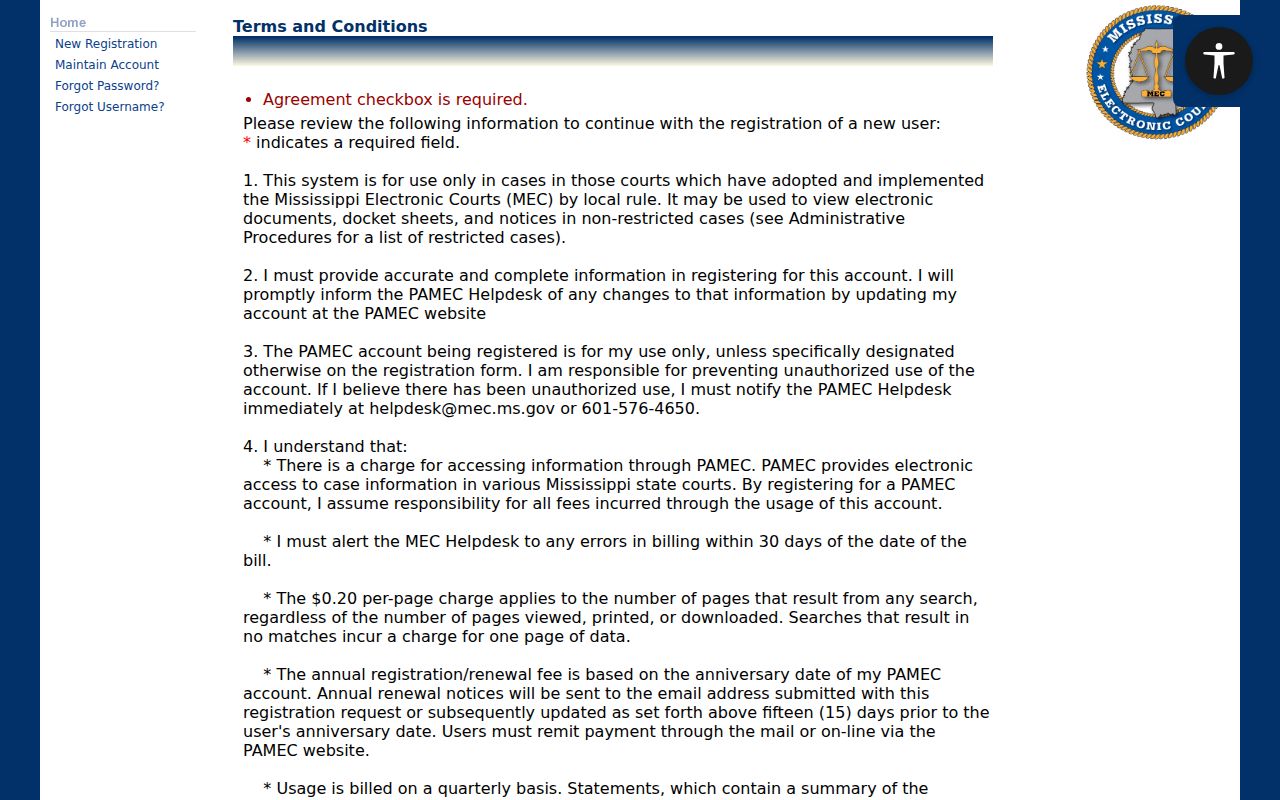
The PAMEC terms govern remote access only. They grant no new rights to sealed material, and they do not pull lower-court dockets outside the system into the search.
Public Access to Civil Dockets
Mississippi treats public records and court files as two related but separate things. Mississippi Code Sections 25-61-5 and 25-61-7 set the procedures. They also let covered public bodies charge actual-cost fees. Court dockets answer to their own rules, though. MEC procedures, redaction duties, and court orders all shape what a Newton County clerk can release. Walk into a clerk office and public electronic access is free during regular hours. Remote PAMEC access works differently: registered, and fee-based.
What you may see in a Newton County civil docket depends on the procedure or order that governs it. Some material stays out of reach. Personal data, minor identifiers, family records, financial information, sealed papers, and expunged material can be redacted. Some may be withheld entirely. Paying for a remote account does not widen that limit. So ask the clerk for the public docket index. Or ask for a redacted public version. That beats chasing a restricted record through another channel.
Protected material: A public docket index may not make every document public. Youth records, sealed or expunged matters, minor identifiers, financial details, and restricted attachments remain subject to the applicable rule or order. Ask for a public version or the index rather than trying to bypass a restriction.
Newton County Civil Docket Copy Routes
Once the docket points you to the item you need, match the request to the right court. Also match the copy type. The Circuit Clerk's posted schedule is the place to check. Staff copies run $0.50 per page. Electronic copies, whether by staff or self-service, cost $0.25 per page. An official seal or certification adds $1 per document. Records research bills at $20 per hour, with a one-hour minimum. Remember, those figures come from the Circuit Clerk's published schedule. Chancery, Justice Court, and municipal clerks set their own amounts.
Appeals carry their own charges. A Circuit civil appeal from a lower court is listed at $161. An appeal to the Mississippi Supreme Court runs $200. For Chancery files or lower-court records, ask the keeper of that file for the current amount. Ask whether certification is available too. When you contact the office, state the court, the case number, the document title, and the date range. Add your delivery method and your willingness to pay quoted charges. That detail helps staff pull the correct court record fast.