
How to Search Criminal Dockets
Newton County Circuit Court takes part in Mississippi Electronic Courts. Registered PAMEC access lets the public read participating case files remotely. The Circuit Clerk is the other main route. Start with the court named on your paperwork. Justice Court holds county misdemeanors and traffic outside the municipalities. Municipal clerks keep offenses inside their city limits. A case that started in Justice Court can later produce a Circuit Court appeal or a felony proceeding. Yet the two records stay separate. Don't treat one search as covering both.
No single public web index combines these offices for Newton County. Take a citation or a lower-court notice straight to Justice Court or the named municipality. A Circuit filing might follow, but that doesn't change where you start. With a felony, the preliminary or bond event may sit in Justice Court. The Circuit Clerk keeps the indictment and trial record. Write the court name next to every search note. A missing PAMEC result doesn't mean the case is missing.
- Identify the court, case type, and any case number shown on a notice.
- For a Circuit matter, use PAMEC or ask the Circuit Clerk for the docket index or public terminal.
- Use a case number first; if it is unknown, narrow a name search with the available date or case-type details.
- Read the dated events, status, and document titles before drawing a conclusion from one entry.
- Contact the responsible clerk for a copy, a certified document, or a lower-court record.
Newton County Criminal Clerk Search Preparation
A good request to the Circuit Clerk names the court and the case number if known. It also gives the name as it appears in the file, a date range, and the exact result you want. You can ask for a public docket index. That could be a copy of a document, a certification, or records research. Fees differ by service. The clerk's posted schedule lists a $10 criminal-record search. Records research runs $20 per hour with a one-hour minimum. So be clear about the service before staff begin work.
When a matter might be in Justice Court or a municipal court, confirm which office has custody first. Do this before asking the Circuit Clerk to search. A county misdemeanor, a county traffic citation, a bond event, or a preliminary proceeding can all rest with the lower-court clerk. That can hold even after a felony case reaches Circuit Court. Handing over lower-court case details along with the Circuit number, when you have one, helps the office. It can tell a Circuit file from a related but separate record.
Newton County Criminal MEC Access
Newton County Circuit Court joined MEC on September 16, 2024. Older material may still require a trip to the clerk's office. Electronic participation doesn't turn PAMEC into a full Justice Court or municipal index. Public users get read-only access. The terms list a $10 annual registration charge. Searches add $0.20 for each result page. That includes the single page you get when a search finds no match. Searching a known case number is far more precise than opening a broad name result.
The per-page charge applies whether you view, print, or download results. PAMEC bills quarterly. That pricing rewards confirming the court and the year before searching a similar name. Remote access lets you read permitted docket material. It does not let you file a paper. It won't get you a clerk certification. And it won't show a document withheld by rule or order. The Eighth Circuit MEC Court Information page posts the court's electronic-access details.
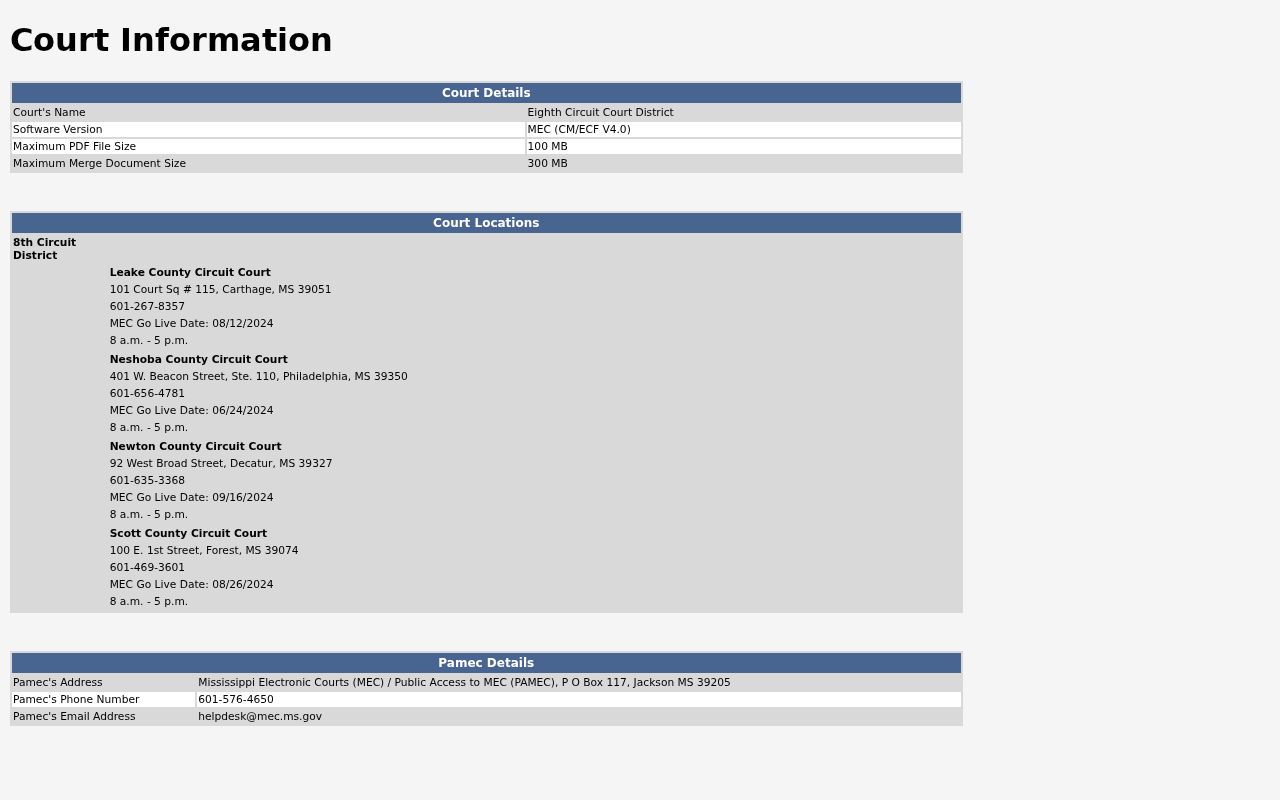
The CourtInfo listing is the source for the Circuit Court's electronic-access milestone. It does not replace the clerk's official case file.
What a Criminal Docket Shows
The Circuit Clerk describes the general court docket as including parties, pleas, indictments, lower-court appeals, and references to orders in the minutes. Read a criminal docket as a chronological index. It is not a transcript, and it is not a finding about a person. The event date, the document title, and any later order give each entry its context.
| Case number | The court-assigned identifier, such as 2024-CR-00001; use the exact number shown by the court rather than assuming a local format. |
|---|---|
| Charging event | A complaint, affidavit, indictment, or related entry identifying the procedural stage. |
| Setting | An arraignment, pretrial, motion, trial, or sentencing date entered by the court. |
| Plea or order | A dated docket event that should be read with the linked or referenced order when public. |
| Status or flag | Markers such as sealed, stayed, appeal, or pending fee that require the surrounding events for context. |
Newton County Criminal MEC Flag Context
MEC shows dated events, document titles, and system flags. But the labels only make sense in sequence. A marker like appeal, pending fee, probation violation pending, trial pending, or order to be entered may describe a workflow stage. It may not be a finished result. Check the flag against the event date and any later public order. Read it as the current case status only then.
Charging words and outcome words do different jobs. An indictment is a grand-jury charging instrument. An arraignment addresses the charge and the plea posture. A disposition is the court's recorded resolution. An arrest, a capias, a plea, a conviction, and an expungement-related entry are not interchangeable. If a permitted linked document isn't visible, ask the clerk for the public docket index. A public copy works too. Guessing from one label is the wrong move.
Newton County Criminal Court Routing
Why would a Circuit Court docket search come up empty for a Newton County criminal case? Routing is the answer. Misdemeanors and traffic tickets filed outside a city start in Justice Court. Felony bond hearings plus preliminary proceedings often begin there too, before the case heads toward Circuit Court. Indictments and felony trials belong to Circuit Court. An offense inside Newton, Union, Decatur, Hickory, or Chunky may instead land in that city's municipal court.
None of this says anything about guilt. It is pure procedure. A Justice Court entry might mark a preliminary-stage event. The Circuit docket later picks up the indictment, arraignment, motions, a trial setting, or the final disposition. Municipal cases stay with the city clerk. A rule, transfer, or appeal can move a related record elsewhere. Before ordering a copy, ask the clerk which court actually holds the file right now.
| Court | Typical Newton County criminal record | First clerk route |
|---|---|---|
| Justice Court | Misdemeanor, county traffic, bond, preliminary, or warrant matter | Justice Court Clerk |
| Circuit Court | Indictment, felony trial, general criminal filing, or lower-court appeal | Michael L. Butler, Circuit Clerk |
| Municipal Court | City-limit traffic, ordinance, parking, or locally assigned offense | Relevant city or town court clerk |
Stages on a Criminal Docket
A Newton County criminal docket can carry many kinds of entries. Complaints and affidavits, arrest or bond events, preliminary hearings, bind-overs, indictments, arraignments, pleas, motions, trial settings, verdicts or dispositions, sentencing, probation entries, cost bills, appeals, and expungement events all appear. Few cases hit every stage. Pay close attention to the dates. A later order can rewrite an earlier setting or status.
Docket flow: Filing or charge › arraignment › pretrial › plea or trial › disposition › sentencing or appeal.
Newton County Criminal Appeal Record Custody
Justice Court and municipal cases can reach Circuit Court through the appeal procedure. The lower-court record does not vanish, though. The Circuit docket sits alongside it. An appeal flag tells you a review is happening somewhere. Reading it takes both the court name and the full docket history. Want the original citation, a lower-court setting, or a local disposition? Start with the clerk who ran that proceeding.
For a Circuit appeal record, bring the lower-court case details. Add the Circuit number if you have one. The Circuit Clerk keeps lower-court appeals. Justice Court and each city clerk hold their own systems. Keep those custodians straight. Treating PAMEC, a Circuit clerk search, or a payment lookup as one complete criminal docket for every Newton County court will leave gaps.
Newton County Criminal Docket Terms
Most docket terms describe steps, not results. An indictment is a charging instrument. An arraignment addresses the charge and the plea posture. A bind-over means the case moved from a lower proceeding toward Circuit Court. A capias or bench-warrant entry demands a careful read. Check its date and any later return status.
Labels like probation violation pending, plea pending, trial pending, or order to be entered are statuses. They are not final outcomes. Put the event date, the document title, and any later order side by side before drawing a conclusion. If a linked document will not open, the responsible clerk can tell you whether a public docket index or a permitted copy exists. The clerk will not interpret the law for you, though.
- Nolle prosequi
- An entry ending a prosecution; read the exact order and any later action.
- Disposition
- The court's recorded resolution, which should be distinguished from a charge or a hearing setting.
- SEALED or expunged
- An access restriction, not a reason to seek material outside the authorized public record.
- Appeal
- A related review posture that does not erase the lower-court case.
Which Court Holds Criminal Dockets
Need Circuit Court criminal dockets in Newton County? The office to call is Michael L. Butler's Circuit Clerk. That office holds Circuit civil and criminal filings, indictments, motions, summonses, judgments, and lower-court appeals. Chrissie Buffington's Chancery Clerk office does not keep ordinary criminal dockets. Justice Court and municipal court clerks are separate custodians with their own records. To confirm the county's District 8 Circuit setting and route your request to the right office, check the clerk's own courts page at Newton County Circuit Clerk courts page. It lists the court information the office maintains.
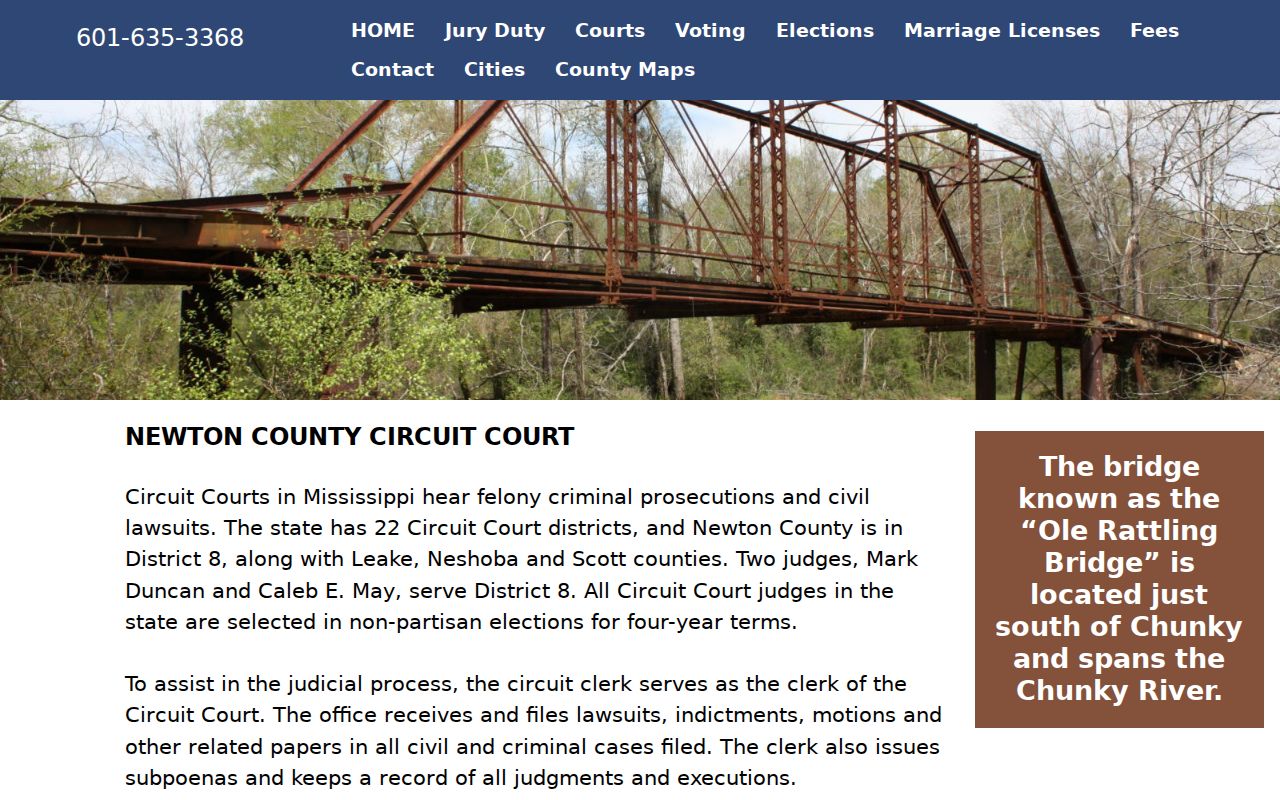
The clerk's court information names the local Circuit Court setting and points criminal docket requests to the right court first.
Newton County Criminal Record Fees
Fees for Newton County criminal records are set out in the Circuit Clerk's published schedule. A criminal-record search costs $10. Records research runs $20 per hour, one-hour minimum. After costs and fines are paid, an expungement petition carries a $150 charge. The schedule only sets prices. It does not promise that every record is open or that every case qualifies for expungement, so confirm details on the Newton County Circuit Clerk fee schedule, which lists these charges and more.
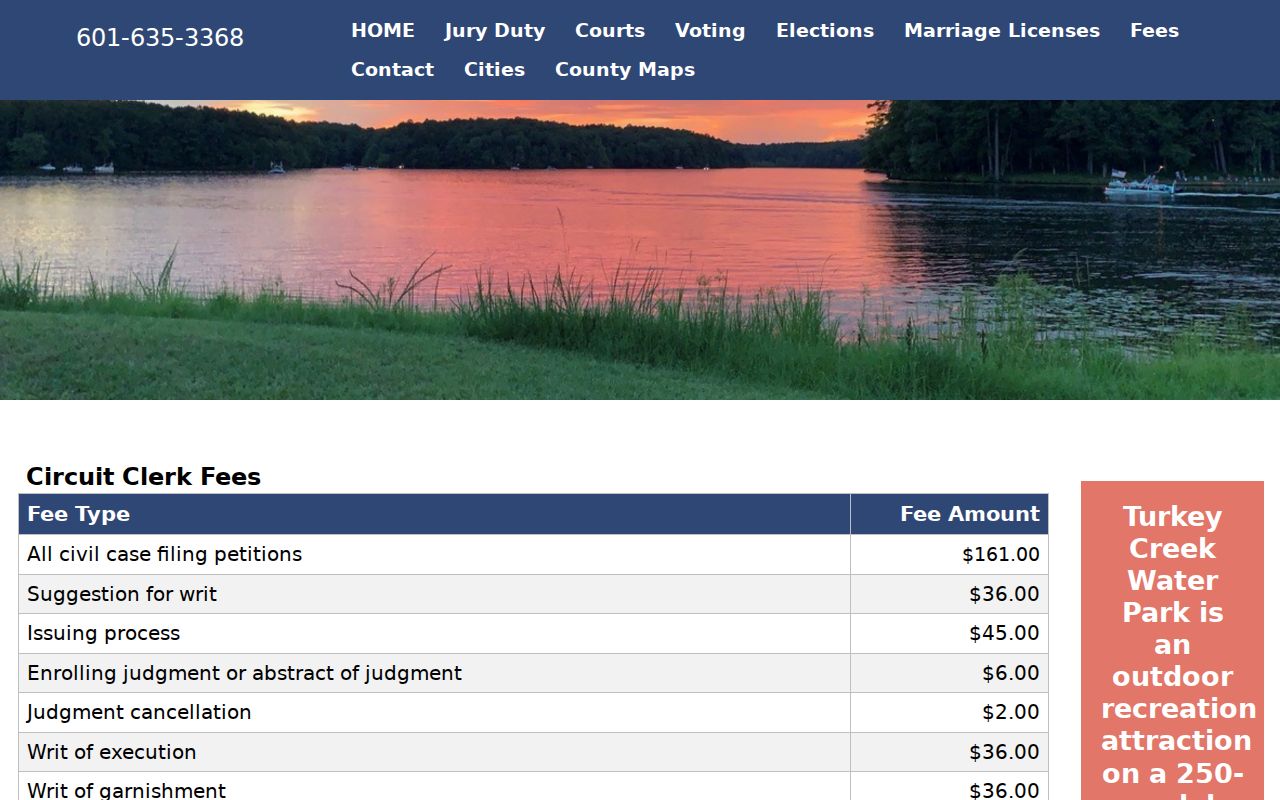
Ask before you pay. Confirm the current fee, the scope of the search, the payment method, and whether you are ordering a search, a copy, or a certification.
Expungement caution: Eligibility depends on current law and the particular case. A sealed or expunged entry is not a public-record search shortcut.
Public Access and Sealed Criminal Dockets
PAMEC can return permitted Circuit docket sheets and documents. That does not make everything public. An index entry may sit next to a restricted file. The MEC procedures give free public electronic access at the clerk's office during regular hours. Copying fees and restrictions still apply. Youth-court records carry special confidentiality rules under Mississippi Code Section 43-21-261. Each court's own procedures control restricted material, not a broad county-records assumption.
Sealed, expunged, redacted, and youth material stays restricted in every channel. Paying for PAMEC access or a records search buys no extra viewing rights. Ask the custodian for the public docket, the public version, or the redacted item. That item may lawfully be released. If a statute, rule, or court order requires a denial, accept it.
Access rules: Mississippi Code Sections 25-61-5 and 25-61-7 address public-record procedures and actual-cost fees for covered public bodies. Court files are also governed by MEC procedures and court orders. Request a public index or redacted copy when a document is restricted; do not request protected youth, sealed, or expunged content.
Newton County Criminal Clerk-Terminal Access
The clerk's office has a public terminal. It gives free electronic access to a Newton County Circuit Court criminal file during regular hours, under the MEC administrative procedures. This route matters when remote PAMEC result-page charges would make a wide name search expensive. Older records may need staff guidance too. Copies, certification, and restricted documents still carry the clerk's published charges and the applicable court rule.
Come prepared. Bring the court name and any case number. Add the party name exactly as it appears in the record. Add a date range and the specific result you need. A clerk can tell these apart. A docket index, a document copy, a records-research request, and a lower-court appeal record each get different handling. Staff cannot interpret an order or give legal advice.
Some Newton County records still sit in paper. Others have not migrated into the newer Circuit MEC history. Ask whether staff can locate such a file from the case details you provide. Phone, mail, fax, and published email contacts work for questions about office procedure. But email and fax are not electronic filing under the MEC procedures. Before sending anything, confirm the accepted request format and payment method.
County misdemeanors, traffic cases, bonds, preliminary proceedings, and municipal offenses belong to the lower courts. Confirm the right lower-court clerk before paying for a Circuit search. The terminal and PAMEC open participating Circuit records. They do not replace a Justice Court or city-court docket. Was the case appealed? Give the lower-court case information along with the Circuit Court number when you know it.